The Game of Life
Last and First MenThe Game of Life is the central insight of the prophet’s mature teaching: life demands wholehearted participation, but its meaning cannot be reduced to winning. A person caught inside events may experience loss as catastrophe; from a wider vantage, the same events belong to a larger whole in which losing, as well as winning, can be good. The teaching does not counsel indifference. It asks for strenuous engagement joined to a freedom from treating success as the ultimate prize.
The Game and Its Players
The prophet explains the principle through ordinary games. Players should strain every muscle to win, yet care less about victory than about the game itself; on this account, that very freedom makes them play better. The distinction is not between effort and passivity, but between taking the contest seriously and mistaking its outcome for the whole of life. Victory pursued as an absolute can destroy the activity it was meant to serve.
His contrast is between Patagonians and barbarians playing against a Patagonian team. The barbarians become consumed by the result: when they are losing, they turn savage; when winning, they become blatant. In either case, they murder the game because they can no longer see the lovely thing their conduct is destroying. Their harassment of the umpire extends the same confusion. The prophet admits that he too once cursed life’s umpire, then says he learned to laugh at the figure people set up in the umpire’s place, and eventually to laugh with him at his own earlier blindness. The image makes life’s apparent authority less an object of bargaining or resentment than a perspective through which human striving can be seen anew.
The Mountain and the Change of Perspective
The prophet traces his lesson to a near-fatal ordeal on Aconcagua. Caught in a blizzard among the snowfields and precipices, he was carried away, struggled for hours, and fell into a snowdrift. Unable to rise and with his head buried, he thought of death with anger because so much remained for him to do. In that extremity, his understanding changed: he saw that he was losing, and that losing could be good because the game itself mattered more than victory.
The change is described as a release from blindness and servitude to winning. He imagines seeing himself and everyone else through the umpire’s eyes, as an actor might see the entire play, including his own part, from the author’s place in the auditorium. Within the play, his situation is terrible: a capable man has come to grief through his own carelessness before finishing his work. From the spectator’s wider view, however, the same situation becomes excellent within a greater excellence. The analogy holds together the intimate force of suffering and the possibility of seeing it as part of a whole; the wider view does not erase the character’s predicament, but changes how it is understood.
That vision expands beyond the individual. The prophet says he seemed to see a thousand worlds participating in a great show, all regarded through the playwright’s calm, exultant, almost derisive but not unkind eyes. The episode does not end in death: strengthened by this new view, he struggles free of the drift and returns. He calls himself a new man, describing the result not as a return to youthful excitement but as a more intense, still form of aliveness. The ordeal thus gives the teaching its decisive reversal: the moment when his own work appears cut short becomes the occasion for recognizing a value larger than completion or victory.
From Youth to Maturity
The Game of Life also revises the prophet’s earlier appeal to keep young. In the temple speech, he recalls that as a boy he urged people to remain young, and that they applauded while clinging to their toys and refusing to grow up. He does not simply retract that message. Keeping young still means remaining supple and keen; growing up means rising into finer skill in the actions of living, rather than sinking into stiffness or disillusionment. The two demands belong together: youthful responsiveness without development becomes arrested life, while maturity need not mean the loss of energy.
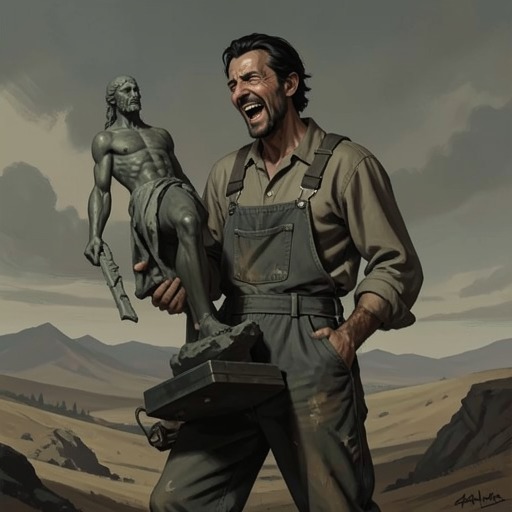
This maturation changes the meaning of reverence as well. The prophet condemns the worshippers’ adulation of life itself and their obsequious attempts to win favor from Power. He urges them to relinquish the image they have made in their hearts, just as he smashes the temple idol. The scene gives the doctrine a public and confrontational form: after he ridicules the image and challenges the congregation, he calls on them to break its hold over their understanding. The temple authorities arrest him; he is tried for sacrilege and executed. His action makes the teaching inseparable from its danger, but his followers chiefly emphasize the iconoclasm rather than the spirit of the exhortation. The cult of the Divine Boy becomes popular even though its adherents do not truly understand his final message.
Reception and Historical Significance
The teaching’s later recovery shows that its meaning outlasts the first audience’s incomplete reception. When the Second Men reconstruct the Siberian Stone Library, the recorded sacred text of the Life of the Divine Boy supplies the prophet’s last words. The tablets matter to them not only as evidence about an earlier species, but because this particular passage speaks to a question they recognize in their own experience.
For the First Men, the dispassionate ecstasy expressed by the prophet had been an ideal rather than an experienced reality. The Second Men, by contrast, recognize an intuition already familiar to them. The tortured geniuses of the Yangtze Valley had expressed something similar; later, healthier generations had also experienced it, though with shame, because it had been associated with morbid mentality. The Second Men are beginning to seek a wholesome expression for that experience, and the remote prophet’s life and last words offer one that is not wholly inadequate. The narrative says their species will soon need this gospel. In this return, the Game of Life is not merely a Patagonian cult’s inherited slogan: it becomes a resource for a later people trying to understand an experience they had known but could not confidently accept.